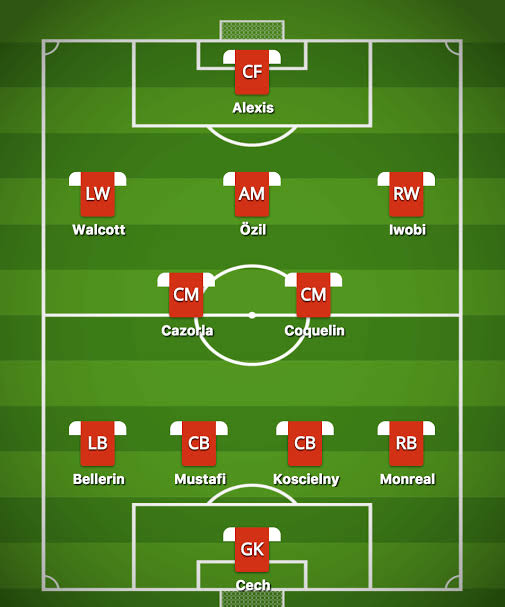
The Goalkeeper
A goalkeeper role in this formation is to keep a clean sheet and be confident taking back crosses. The density in the middle created by the two CDMs and the two full backs will drive the opposition to concentrate on attacking using the wings.
The goalkeeper should be agile and a good communicator, as he is tasked with guiding his defence and help them close gaps and spaces that the opposition can exploit.
As the team pushes forward he must stand guard at the edge of the penalty area and should not lose focus when his team has the ball, which will be the case most of the time, so he can clear balls played behind his defence line back.
The central defenders
The danger will mainly be brought from the wings.The defenders should be able to read and clear crosses whether it’s at head level or foot level.
Due to the constant offensive help that the fullbacks provides to the team when attacking, it is the role of the central defenders to cover for them whenever they move forward.
The whole defence should work in unison to keep their clean-sheet. a good Communication skills are demanded from the defenders and the midfielders to cover for each other. For example, if a central defender desert his post to cover for the fullback he must coordinate with the CDM and the other centre back to shift their positions following him to seal the space created by his movement.
In the 4-2-3-1 formation the centre-backs should be well-protected by the midfielders in front of them. However, they need to make sure that the midfielders do not drop too deep or push too far forward.
The fullbacks
As we mentioned earlier, the oppositions attack will be mainly concentrated on the wings. So the fullbacks will have their hands full pretty much the whole time
The fullbacks need to have the upper hand over the opposition wingers and always prevent them form crossing the ball to the penalty area.
A good positioning skills are need to drive away danger, they should be good at reading the gameplay and decide whether they should go get the ball from the opposition at the wing or drop back to the penalty area to prevent 3v2 situations in the box.
They should be good on the ball, decent dribblers, and be able to deliver a dangerous ball into the box. It is their movement both on and off the ball that provides the forwards on their side of the pitch with space within which to play.
They should be extremely to dominate their flank both in attack and defence the whole 90 minutes.
By staying wide they give more space to the midfielders to get the ball to the opposition’s danger area.Advertisements
The central midfielders
The 4-2-3-1 football formation aim at bossing the game and maintaining an equilibrium while attacking.
The two central midfielders in front of the defence have a responsibility of compressing the space in front of the goalkeeper.
They should maintain the distance between them and the line of defence. They should not drop too deep to keep from isolating the forwards and they shouldn’t stray too high and expose the defenders.
They have a responsibility of covering for the fullbacks when they go up and leave spaces behind them.
The two central midfielders selected will vary in their abilities depending on how the coach likes to line up. One of them will nearly always be a specialised holding defensive midfielder. If playing an attack-minded team, the other one may also be a defensive player.
Regardless of their role on the pitch the two central midfielders should be able to move the ball form the defence to the forwards in front of them. Basically, their passing skill and their understanding of the game should be top notch.
The forwards
In the 4-2-3-1 football formation the three forwards open the room for a multitude of variations depending on the players the coach has in his arsenal. He can align fast players to stay out and widen the field or creative players to move in the space between the lines.
The combinations possible between the three forwards, the striker and the pushing fullbacks are endless. You can play wide and deliver crosses to the players in the box or combine with the striker and push from the middle. It all depends on the qualities on your team.
The three players have the responsibilities of creating dangerous situations and scoring goals. Using the freedom they have in the final third and the possibilities they have with the ball it is extremely difficult to counter them.
The numerical superiority guaranteed by the players in the final third make it possible for the team to create 2v1 situation all over the pitch. If used correctly the passing lanes and the triangles created by the movements of the three forwards make for a fluid and fast movement of the ball from the midfield to the penalty box of the opposition.
The central attacking midfielder is often the playmaker of the team and, as well as creating chances, needs to offer a potent attacking threat in the opposition’s box. Like the other forwards, they are at times expected to push on past the striker and use their movement and skills to create space and opportunities for their teammates to exploit.
When the team loses the ball the front three are expected to act as the first shield protecting the goalkeeper. The number of attacking players in the final third associated with an intense pressing strategy will force the opposition to make a mistake or play the ball long.
The striker
Score the goals man !! duh !!
All the efforts Starting from the goalkeeper lead to placing the ball in front of the striker in the most dangerous area of the field and he has to finish the job of his teammates.
Depending on the tactics adopted for the game and the opposition weaknesses you can choose between a classic big target man as a strike or a fast player to lead the offence.
With a big target man up front, the forwards can play into their feet and expect them to hold the ball up and bring others into play.With an imposing player to aim for, the forwards out wide should put in crosses at head height and hope to take advantage of their aerial prowess.
If a mobile striker is selected, the team’s attacking dynamic changes completely. This type of striker should aim to use their pace and movement to drag the opposition’s defenders out of position and run in behind them.
It is their movement and interchanging of positions with the forwards behind them that can cause havoc to the opposition if executed correctly.
Regardless of which type of player is selected, the striker must have a great shot, be very accurate, and be able to put away any opportunities.
Roles and responsibilities
We will start the analysis with the players’ responsibilities in the 4-2-3-1 formation, from the back the goalkeeper must be good at organising the team. Many dangerous situations can be avoided if a goalkeeper knows how to organise the team while defending. A goalkeeper has to be tall, with good reflexes, and be able to stop the shots from various distances. Modern football demands the goalkeepers be able to pass the ball, and be part of the build-up phase. That gives an extra advantage to the team with an extra player.
The full-backs are two of the fittest players in the field. Full-backs should be fit, as depending on the manager’s game model, they should participate within the offensive part of the game by over or under-lapping the wide attacking midfielders, and they have to be able to deliver the ball into the box. Additionally, full-backs must be good defenders, as most of the time, they have to deal with the most technical players of the opposition, like wingers, or wide attacking midfielders. Full-back’s spaces are the wide areas, and they could go inside to support the team either when in possession, or when the team is defending. The two centre-backs must be able to defend in a 1-vs-1 situation and understand both zonal and man-to-man marking. They have to communicate with each other and be able to organise the team from the back. Depending on the manager’s game model, centre-backs should be good with the ball on their feet, as they are starting the possessional game of the team. The image below demonstrates the areas that the players are moving during a game.

Going higher in the pitch, and analysing the two midfielders, someone can notice that this formation divides the responsibilities among them. There is a defensive midfielder, that is moving in front of the defensive line and is trying to hold the balance. For that reason, that player is mostly a strong physical player that can deal with ground and aerial duels. Moreover, this player, many times, acts as a linking player between the defensive and the offensive line, as he receives the first pass from the back. There are times that the defensive midfielder will go higher in the field to cover the central midfielder. The central midfielder is a more technically gifted player. He has to be strong, physically fit, quick, and with a high level of endurance, as he supports the team with and without the ball all over the field. He must be a player that can penetrate the opposition, and break lines with his passes, as his team has more chances to win the game if he manages to pass the ball well from midfield. The image below is showing the areas that the two midfielders are covering, depending on their role during a match.


The players that are in the midfield area must be conditioned for endurance, electric speed, and technically gifted. That will allow them to go engage 1-vs-1 situations and overcome their opponents. Specifically, the attacking midfielder must be unpredictable with the ball on his feet. He must be able to penetrate the opposition’s defensive line. Moreover, he must know to take advantage of the free space and either drive the ball in there or make a pass. Overall, the central attacking midfielder or number ’10’ must be a continuous threat for the opposition with and without the ball around the box. Except the above, the number ’10’ must be able to defend, as modern football demands from him to participate in the game when his team does not have the ball, as well. The wide attacking midfielders have to be exceptional dribblers and unpredictable. They must have the ability to deliver the ball into the box, and be good at combination play. They have to read the game and possible scenarios and take advantage of possible weaknesses of the opponent and exploit them. Without the ball, these players have to support the full-backs defensively. That is the reason why they have to be in excellent physical condition. A crucial factor for the success of this formation has to do with the partnership between the full-backs and the wide attacking midfielders when defending and attacking. Below there is an image with the areas that the players are moving during a game according to their positions.

Because of the formation, the centre forward has to be physically strong, and able to receive the ball under instant pressure. That is because he is the only striker, and for that reason, he has to face two or three defenders. The striker must be quick with electric pace, and able to read the game to exploit free spaces or take better positioning from the defenders. He must have the ability to score from different distances and in different ways. Moreover, he must be able to play away from the box. On that way, he will support the possessional play and will create spaces that the attacking midfielders can take advantage of. Specifically, the centre forward and the central attacking midfielder have to cooperate and have excellent communication on the field, as they can exploit opposition in many different ways, and especially by creating free spaces with their movements. Despite that, the centre forward is the first defender of the team. For that reason, he must have the physical condition to press high and try to regain the ball. Below is an image that is indicating the area that a centre forward is moving within the 4-2-3-1 formation.
Build-up
One of the most common ways that we meet in the teams that are using the 4-2-3-1 formation when they are trying to build up their game from the back, is the two centre backs go wide to receive the ball from the keeper. The full-backs are taking a higher position in the middle third of the field, and usually, the defensive midfielder, is a bit deeper, comparing with his partner in that area. With these movements, the team is trying to stretch the opponent. By doing the team will gain more space to pass the ball, and eventually move it forward throughout the thirds. Free space in football means more time. So, these coordinated movements in the field are crucial for the team to get the ball out of the back safely. A pass from the goalkeeper into the centre-backs or the defensive midfielder that came deeper seems a reasonable option for the goalkeeper.

There is always the option for the opponent to press high in the pitch. On that occasion, and if the opponent is pressing with two strikers, an option would be the defensive midfielder to drop either among or next to the two centre-backs. On that way, the team with the 4-2-3-1 formation gets over with the numerical disadvantage and has more chances to transfer the ball from the back. The rest of the players have a similar position as before and try to stretch the opponent’s formation and exploit any possible gaps and weaknesses.

If the opponent adjusts on this change and starts pressing with three players, then the next option could for a full-back to come deep – next to the final line – and ask for the ball. On that way he sets a dilemma for the opponent: either one of the opponent’s players is following him, but then there is a lot of free space in-between the lines, or no one is following him and let him receive the ball and start the possession game. The defensive midfielder could support him and move to that space that there is a lot of free space. The full-back’s movement is an interesting move, as we do not see it often. Moreover, this move could cause problems at the opposition’s high pressure, as the formation is going to be stretched and the team with the 4-2-3-1 formation could exploit the free space.

Another option for the goalkeeper if the opposition adjusts in this scenario could be a long ball into the wide areas. Teams that pressure high usually do it with three or four players. So, if the goalkeeper tries a long ball into the wide areas, to one of the two full-backs, then automatically passes over the opposition’s high defensive block. The issue then is that the players around the full-back have to support him immediately to retain the possession of the ball and start the possession game from the middle third of the field.
Possession throughout the thirds
After the ball has left from the goalkeeper, the carrier of it has to transfer it forward. Supposing that the ball is on the feet of one of the two centre-backs or at the full-back, their first job is to make sure that they will not lose the ball in a dangerous area. The ideal scenario for the carrier of the ball is to pass to the defensive midfielder, who is moving in a deep position. By doing so, the centre-back will achieve to transfer the ball into a key player. That will help the team to transfer the ball throughout the thirds.

When the defensive midfielder receives the ball, he has several options in different combinations that could lead to a dangerous situation in the opposition’s half. The first option evolves the attacking midfielder, who is positioned in the midfield area: The defensive midfielder passes to him, and he tries to play the ball at the central midfielder, who is positioned a bit deeper and wider in the field. By transferring the ball back and forth, the players achieve to disorganise the opposition’s defensive structure, as the ball is moving quicker than the players of the opponent can adjust. When the central midfielder receives the ball, he has to pass it into the wide areas, where the full-back has already started the run to overlap the wide attacking midfielder. This quick combination that demands the full-backs to have a high position in the field.

The second option is for a team that the manager does not want the full-backs to play in such a high position. To get the ball into the same area as before, the centre forward must be evolved in this scenario: The striker is moving deep in the field to support his teammates while in possession. On that way, the centre forward not only supports the team but also does he create free space in his back that one of his teammates could take advantage of. The defensive midfielder passes to the centre forward. The striker tries to find with a quick back pass to the attacking midfielder, who supports him on a diagonal position. The number 10 passes a forward pass to the wide attacking midfielder, who has started his run. The wide attacking midfielder can move either wide, either to take advantage of the free space that the striker created.

A third option that a team could develop the attack with the 4-2-3-1 formation is with the direct contribution of one of the full-backs. Some teams try to keep a compact shape when defending, and it is tough for the midfielders to exploit the space. For that reason, a full-back could step inner in the field and become an extra player. The defensive midfielder will do a pass at the attacking midfielder. He is going to pass to the central midfielder who is moving in a diagonal position for instant support, and then he will pass at the full-back, who stepped at the inner axis of the field to overload the area. The striker on that scenario is a bit higher in the field. The full-back and the striker will try to have a combination game to transfer the ball at the flanks, where the wide attacking midfielder has already started his run.

Those were some possible scenarios that could happen when the opposition team is pressing up high. There will be some teams that will give space and will wait for their opponent with a medium defensive block. That will give the flexibility to the team to step higher in the field, and pressure the opponent with more players in his half. For example, if a team that plays with the full-backs high, they could take a high and wide position in the field, while the wide attacking midfielders would be inner and closer to the opposition’s box. By taking such a position, the wide attacking midfielders could receive the ball closer to the opponent’s box. Taking as a fact the characteristics of those players, we could see how dangerous this could be for the opponent. The only player that is deeper in the field is the defensive midfielder, who tries to retain a balance between the line. The players that try to break the opponent’s line are the central midfielder and the attacking midfielder that are having a position between the half of the field, and the box. After this set-up, the formation seems more like a 3-2-5, with many players pushing around the opponent’s box.

A manager that would not prefer his full-backs high and wide on the pitch, he probably would choose another set-up: with his full-backs in a deeper position and the wide attacking midfielders in the flanks. That would give the chance to them to get the ball wide in the field and go for 1 vs 1 situations and deliver the ball into the box. On that set-up, the opposition is getting stretched again, but it is not so aggressive as the previous one, with at least five players in the final third of the field.

At the final third of the field, the 4-2-3-1 formation provides many different options to finish a chance. For example, is not only two or three players that can be in the box and try to score a goal. Depending on the manager’s philosophy, we could get up to five players around the box. This is a dangerous situation for the opposition to face, as the defenders have to face the striker, the attacking and the wide attacking midfielder, the central midfielder that probably is at the edge of the box, and maybe the full-back that is coming from behind.

The 4-2-3-1 formation without the ball
The 4-2-3-1 formation is slightly different from the other formation, as it is a formation that has an extra line between the forward and the midfielders. That the is the line with the attacking midfielders. That gives extra flexibility to the formation and especially when a manager has as a philosophy to pressure high in the field. If this is happening, then a manager probably would set-up his team very high on the pitch. To do so, the defensive line has to be around half of the field. That would put more pressure at the opposition. The striker, as the first defender has to manipulate the opponent, and drive them with the ball in the space that he wants. The attacking midfielders are high in the pitch and put instant pressure on whoever receives the ball. The defensive and central midfielder are marking their players in their space.

Going a bit deeper in the field, we can see the flexibility that this formation gives: Most of the teams that decide to defend with a medium defensive block, they do it by turning the 4-2-3-1 formation, into a 4-4-2. The attacking midfielder comes next to the striker, while the two wide attacking midfielders step a bit deeper next to the central and defensive midfielders. That formation is not something standard, as we can see. For example, if the ball goes at the flanks, then one of the wide attacking midfielders will step out and will try to push away the carrier of the ball. So, in that scenario, the 4-4-2 is turning into a 4-3-3, as the midfielders and the other wide attacking midfielder are stepping behind him to support his back.


Stepping deeper into the field, this adjustability is becoming more compact. This is because the players are forming a compact low defensive block from at least eight players, who are at a close distance from each other. Moreover, the two midfielders that are taking a position in front of the two centre-backs gives the team extra compactness, as four players in the central axis are creating a box in front of the goalkeeper. In a low defensive block, the only players that are a bit higher in the pitch are the attacking midfielder and the centre-forward to counterattack.

Conclusion
The best defence is to attack as the saying goes. With the 4-2-3-1 football formation the attacking possibilities seem endless and the serenity in the midfield is assured by the two central midfielders.
The shape of the 4-2-3-1 football formation is flexible and you can shift to other soccer systems easily. by taking one defensive midfielder and replacing it by a box to box midfielder you can shift to the 4-3-3 formation assuming you started with at least two forwards that can play wide so you gave the playmaker drop deep and the two forwards go wide to support the striker.
Strengths of the 4-2-3-1
There is a reason why so many soccer coaches have started to use this formation. The advantages below are just a couple of the main reasons why they love the 4-2-3-1 so much.
Covers the Entire Pitch
When played correctly, which isn’t a given with any team, the 4-2-3-1 can be frustrating to face because there is usually a player or two in every part of the field. This is why it is one of the most popular formations right now. It creates matchup problems everywhere and, unless the opposing team is extremely patient, it can open up plenty of scoring opportunities.
The center of the pitch, specifically, is where the formation shines. With five midfielders, teams that utilize the 4-2-3-1 can control the game by forcing defenses to pinch in, leaving space down the sidelines. If the defense doesn’t pinch in, the midfielders can creatively work through the middle of the defense.
More Attacking Options

Teams that use the 4-2-3-1 often have four very good offensive players up front. That is a scary prospect for defenses, and it gets even worse if the full backs are good passers. An even scarier prospect is if one of the central midfielders has offensive skills since they can easily move up and create a matchup nightmare.
Encourages Creativity
Since there are three attacking midfielders in most 4-2-3-1s, there are plenty of chances for creativity. Even if only two of the three are good creators, defenses have to stay on their toes for runs coming from all angles.
The top teams that run the 4-2-3-1 will often allow their players to have freedom all over the pitch. That means that one of the defensive midfielders might join the attack and/or the attacking midfielders can act as second strikers.If you want an opportunity to be a great playmaker, then this is one of the best formations for you.
Weaknesses of the 4-2-3-1
There’s no such thing as a perfect formation, and coaches who run the 4-3-2-1 certainly no that. The three weaknesses below highlight how this formation can be beaten.
More Defensive Responsibilities
The 4-2-3-1 forces normally attack-minded players into having to put in a lot more work defensively. The attacking midfielders, in particular, have to be willing to press high in order to keep the opposition from exploiting holes in the defensive half of the pitch.
Since players have to work harder in this formation, it’s no surprise that their defensive weaknesses are often exploited. It is tough to stay on your game for the full 90 minutes, and opposing teams often need just one chance to take advantage of those weaknesses.
Forwards Can Get Isolated Up Front

Since the 4-2-3-1 has the attacking midfielders helping out on defense, the forward can often get stuck up front on his or her own. That can cause them to get fewer opportunities and it can greatly reduce the amount of time the team has possession of the ball.
The teams that run the 4-2-3-1 the best way usually have an attacking midfielder or two who are engines willing to control their sides of the field. That is a special skill, though, and many teams that use this formation do not have those types of players.
Full Backs Have a Lot of 1-on-1s
Since there are three attacking midfielders in this formation, the full backs are often left to deal with the opposing team’s best outside players. If a counterattacking pass makes it to one of the opposing wingers, the full back will have to stop that winger or he/she will be through on goal.
Many coaches try to offset this issue by deploying their best all-around players on the same side as the opposing team’s top winger. While this is a good idea, it can throw off the offense and leave the striker isolated up top.
Thank you for reading, stay tuned. Keep supporting given below links!

 Jatin Tyagi

